An LC filter is a passive electronic filter consisting of an inductor (L) and a capacitor (C). It selectively allows signals within a specific frequency range to pass while attenuating unwanted frequencies.
LC filters are widely used because of their simple structure, low power consumption, and ability to operate without an external power supply.
The resonant frequency is calculated using:
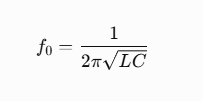
Where:
F0: Resonant frequency
L: Inductance
C: Capacitance
(1) Wireless Communication and RF Devices
LC filters are widely used in smartphones, Wi-Fi routers, base stations, satellite communication systems, and wireless modules. They help select desired frequency bands, suppress harmonics, and reduce out-of-band interference.
For example, in 2.4 GHz Wi-Fi devices, bandpass filters help maintain signals within the target frequency range and reduce unwanted interference.
(2) Power Management and Power Supply Filtering
LC low-pass filters are commonly used in switching power supplies and DC-DC converters to reduce voltage ripple and high-frequency noise, improving output stability and power reliability.
(3) Automotive Electronics
In electric vehicles, onboard chargers, battery management systems (BMS), and motor control systems, LC filters help suppress electromagnetic interference (EMI) and improve electronic system stability.
(4) Industrial Automation and Control
LC filters are used in PLCs, sensors, variable-frequency drives, and industrial control systems to reduce high-frequency noise and electromagnetic interference.
(5) Audio Equipment and Consumer Electronics
In audio amplifiers, speakers, and crossover networks, LC filters separate audio signals into different frequency bands, allowing individual speaker units to reproduce the appropriate frequencies.
3. Comparison of Different LC Filter Types
| Filter Type | Main Function | Typical Applications |
| Low-pass | Passes low frequencies | Power filtering |
| High-pass | Passes high frequencies | Signal processing |
| Bandpass | Passes a specific frequency band | Wi-Fi and RF communication |
| Band-stop | Attenuates a specific frequency band | EMI suppression |
Q1: Why are LC filters suitable for RF communication devices?
A: They provide frequency-selective filtering, allowing desired RF signals to pass while suppressing unwanted noise and out-of-band signals.
Q2: What determines the cutoff frequency of an LC filter?
A: It primarily depends on the inductance and capacitance values. For an ideal LC resonant circuit, the resonant frequency is calculated . Actual cutoff frequency also depends on circuit topology, load conditions, and parasitic parameters.
Q3: Can LC filters be used in high-frequency circuits?
A: Yes. With appropriate component selection and circuit design, LC filters can be used in RF and microwave applications. However, higher operating frequencies require greater attention to parasitic effects, component Q factor, and PCB layout.
LC filters play an important role in wireless communications, power management, automotive electronics, industrial automation, and audio equipment. Their simple structure, passive operation, and flexible frequency selection make them valuable components in modern electronic systems.
When selecting an LC filter, engineers should consider operating frequency, bandwidth, insertion loss, stopband attenuation, power handling capability, and physical dimensions to ensure optimal performance.
Yun Micro, as the professional manufacturer of rf passive components, can offer the cavity filters up 40GHz,which include band pass filter, low pass filter, high pass filter, band stop filter.
Welcome to contact us: liyong@blmicrowave.com


die Anschrift : Xisan Road, Mechanical and Electrical Industrial Park, No.767 Yulan Road, Hefei,Anhui.
Tel : +86-18855146875
Email : liyong@blmicrowave.com


Scannen Sie es